
Introduction to the HXD1C Type Electric Locomotive Project
Introduction to the HXD1C Type Electric Locomotive Project
I. Summary
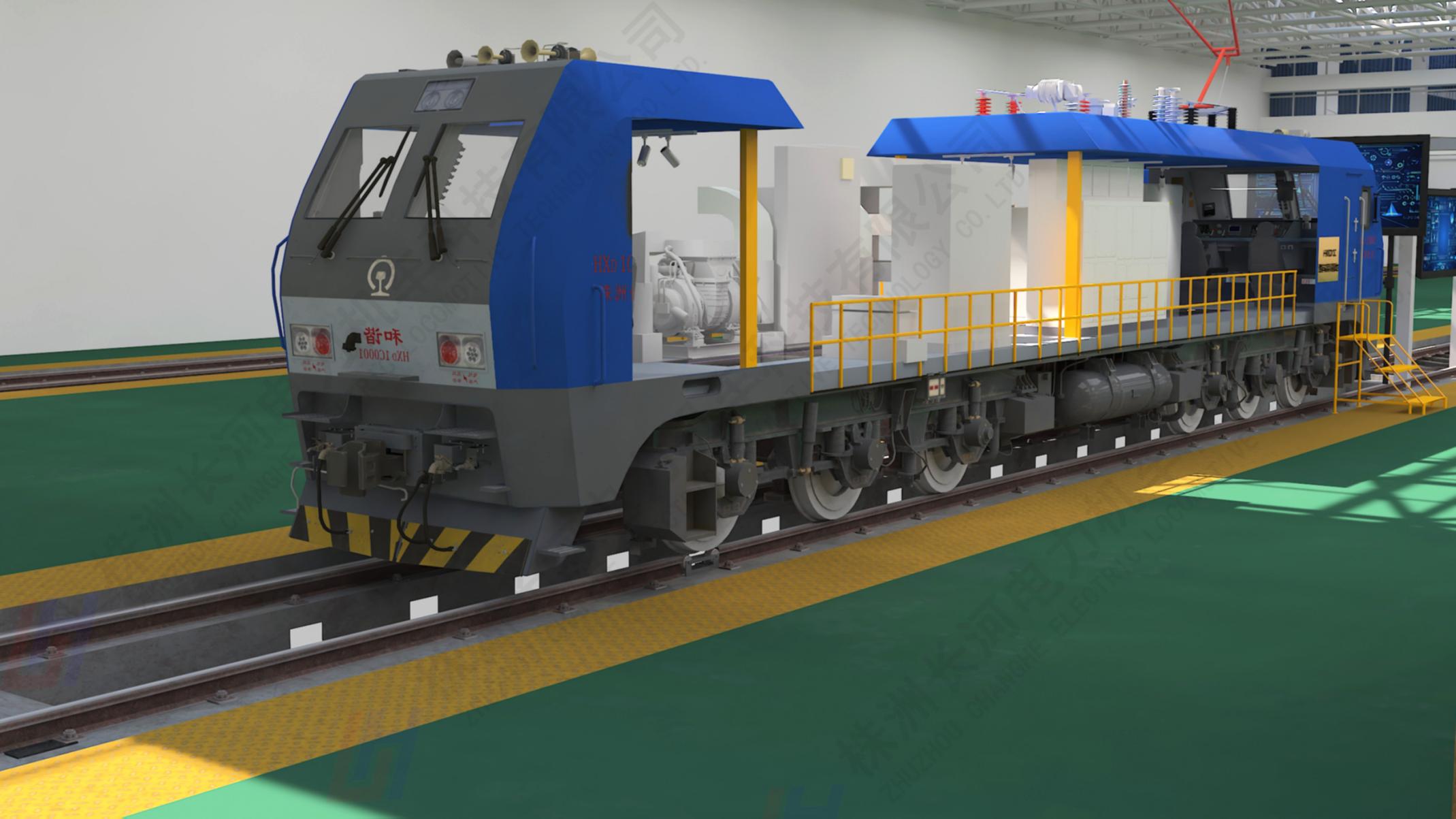
This full-vehicle training project is primarily built around a custom-designed HXD1c electric locomotive prototype. The locomotive’s overall structure features dual driver cabs, with the left-side wall of the mechanical compartment (viewed from the perspective of Driver’s Cab I) incorporating a hollowed-out design, while the right-side wall remains solid. Inside the mechanical compartment, equipment is installed following real-train layout principles—combining authentic components with select model replicas. To address potential space constraints in the mechanical area, equipment like restrooms and tool cabinets, which don’t directly impact hands-on training exercises, have been deliberately omitted. Notably, for components in the original locomotive’s traction system, air supply system, and auxiliary systems that serve identical functions—such as the main traction inverter, air compressor, and auxiliary converter—only a single set of customized, true-to-life equipment has been installed. Meanwhile, the brake control cabinet has been replaced entirely with a model unit, though its physical arrangement mirrors that of the actual locomotive. All other functionally equivalent devices within the mechanical compartment are marked using LED light strips placed exactly where their real counterparts would be located, with each strip clearly labeled to indicate the specific equipment type. For a visual reference, see Figure 2. Importantly, when these devices are operational, the LED light strips automatically synchronize and illuminate accordingly. The central corridor incorporates pre-wiring and pre-piping systems, along with one fully simulated locomotive underframe and two custom-built bogies. Additionally, the setup includes a complete set of roof-mounted high-voltage components identical to those on the original locomotive, one set of locomotive operation support equipment, a simplified simulation-based driving system, a complementary auxiliary teaching system, and a three-level maintenance platform complete with a matching inspection pit (including tracks). Other essential elements, such as a power distribution cabinet, have also been integrated into the system. Crucially, all equipment in the training center has been carefully designed and installed to ensure both safety during hands-on sessions and ease of instruction. Moreover, the equipment’s installation methods, operational processes, and functional capabilities closely replicate those of the real-world counterparts.
Upon completion, the project will enable comprehensive coverage of high- and low-voltage testing for HXD1c electric locomotives, as well as training on locomotive operation procedures, troubleshooting and inspection techniques, maintenance practices, process workflows, and standardized maintenance operating protocols.
The above construction components can be configured according to the customer's site and specific requirements.
II. Brief Description of the Training Content
| Serial Number | Training Hub | Training Site Description |
| 1 | HXD1c Train Inspection |
|
| 2 | Low-voltage testing |
|
| 3 | High-Voltage Testing |
|
| 4 | Normal Driving Test | 1) Pre-trip inspection; 2) Vehicle operation; 3) Handling of sudden traffic incidents; 4) Parking operation. |
| 5 | Comprehensive Joint Training | 1) Vehicle-wide software switching and data viewing; 2) Software operation training, including setting parameters such as wheel diameter, vehicle number, user password, and more; 3) Complete Vehicle Logic Training; 4) Fault Drill Training. |
| 7 | Daily Maintenance and Maintenance Training for Locomotives |
|
Address: Building D1, Area C, China Dynamics Valley Independent Innovation Park, 899 Xianyuehuan Road, Tianyuan District, Zhuzhou City
This website now supports bidirectional access via both IPv4 and IPv6.
Tel:
Email:
右侧在线客服样式 1,2,3 1
图片alt标题设置: ZHUZHOU CHANGHE ELECTRIC LOCOMOTIVE TECHNOLOGY CO., LTD
表单验证提示文本: The content cannot be empty!
循环体没有内容时: Sorry, no matching items were found.
CSS / JS 文件放置地